Well It Feels Like You Have to Put In the Reps
Published:
A note to myself on why one intense session is never enough. On the repetition multiplier hiding behind every piece of work you care about, and how the small, cheap lie of 'let me just be done with it' quietly integrates into regret.

This is a note to myself, written after a realization.
I don’t have a problem with intensity.
My definition of “intense work”: an intense bout or session of work that produces some outcome X. That is not a problem. I can do that. I’ve always been able to do that.
The challenge is, a singular intense session is not enough to produce a substantial or even a good enough outcome.
This sounds simple enough, but it is very hard to understand when you try to run the same analysis on yourself. Or, it takes a lot of time and can take years to understand. And to see it in action, you have to struggle a lot.
Struggle or frustration?? I don’t know, because at this point you’ll be doing both. The two stop being distinguishable somewhere around the third time you’ve given something everything you had and watched it land as “fine.”
Look at it this way:
I’m doing something, I’m putting in the effort, but why isn’t there any outcome yet?? Why is this not at the same level I want this to be at??
A part to understand: every new level of success becomes the minimum level of acceptable progress moving forward. So, if you are good at things, every new piece of work gets compared to the previous good effort, and this creates a problematic loop to acknowledge and get out of. The ceiling becomes the floor. Immediately. Without ceremony.
Now, that’s very hard to understand on your own. But let’s say you’ve done it. You’ve seen the loop.
What’s missing now?? And where do we go next??
- A singular intense blow, call it b.
- b is not enough to produce a certain amount of outcome, call it c.
- So, what are we missing here?
- A repetition multiplier X, such that:

Which rearranges to the only line that actually matters:
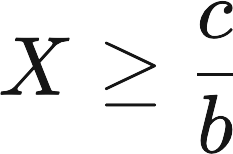
And that makes everything very understandable, and clear. Your intense actions are missing a repetition multiplier.
Note what this equation is telling you. X is not yours to negotiate. c is fixed by how good you want the thing to be. b is fixed by what one honest session actually produces — and you already know that number, because you’ve been running the experiment for years. So X falls out of the division. It is determined. The only thing you get to decide is whether you show up for it.
And what are you actually trying to do instead?
The whole game of performing an intense action is to not have to do it again. Be done with it. But no — any work or task is like a cockroach. A large one. Which flies.
No matter how hard you slam it, a new one comes, and then you look down and realize you’re standing on top of a nest of them.
That’s what it is all about. “Be done with it” is a way of avoiding the task. Being lazy enough to do it once, hard, and then declare the matter closed. One heroic swing, and permission to stop.
There’s nothing more to it than that. And where does the saved time go? Into staring at an array of red, blue and green LEDs producing an infinite set of permutations of colour, which your brain tricks into calling “information.”
So, logically speaking (I mostly speak with emotion), there’s no point in “be done with it.” It’s an illusion. A lie you tell yourself.
But this is an interesting lie, because unlike the other ones, it’s a small one. Nobody catches it. You don’t even catch it.
Let a single one of these small lies be dL. On any given day it’s negligible — that’s the whole point of it, that’s why it survives. But you don’t tell it once. You integrate it:
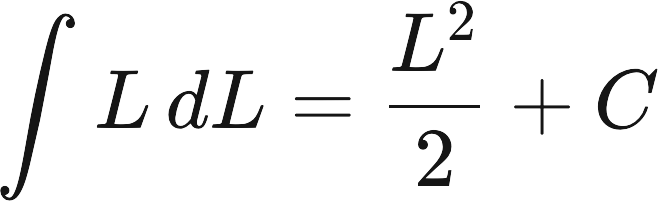
The lie grows quadratically. And the constant of integration, the term that just appears at the end, unaccounted for, that nobody put there deliberately —

Which is exactly how regret works. You never add it. It’s simply there when you evaluate.
So, we have understood.
First, there are smaller sets of lies which are not identifiable in the moment but eventually yield a bigger one. Those lies can be anything. The tell is that they cost nothing today.
Second, whenever you are thinking about a singular intense bout of action to solve a task and be done with it — it’s a trap. A mental trap, and you have to avoid it. It’s avoidance and laziness dressed up as productivity.
Third, X · b ≥ c is always the case. All your actions multiply with repetition. And you can use that to generate good results. The correct model then becomes: how many times do I have to do this, how many times will this be repeated, and when. That’s the default. Not the exception, not the fallback. The default.
Fourth, there’s no fourth right now. KEEP THE THREE ABOVE IN CHECK.
That’s all I have to say right now. Posting it, so that it becomes etched in the internet, and in myself, forever.
Latest articles
Read all my blog postsNovember 21, 2025
AI Psychosis
A dissociative state in which reality is experienced not directly, but as prompts to be engineered; life becomes a series of queries awaiting AI response.
Read moreApril 24, 2025
How to Ride the Wind, or Letting Go
Exploring the Tao Te Ching's concept of 'riding the wind' through the story of a man learning to let go of control and embrace effortless action (Wu Wei).
Read more